
One Ceremony or Two? How to Structure a Fusion Wedding in Italy
If you and your partner come from two different cultures, you have probably already had this conversation. Do we blend everything into one ceremony? Do we hold two? Whose traditions come first, and what happens to the ones we leave out?
Take a breath. There is no single right answer, but there is a right answer for you. And here is the good news: Italy is one of the best places in the world to figure it out, because it gives you something most destinations cannot. Time, space, and complete ceremonial freedom.
Why Italy works so well for fusion weddings
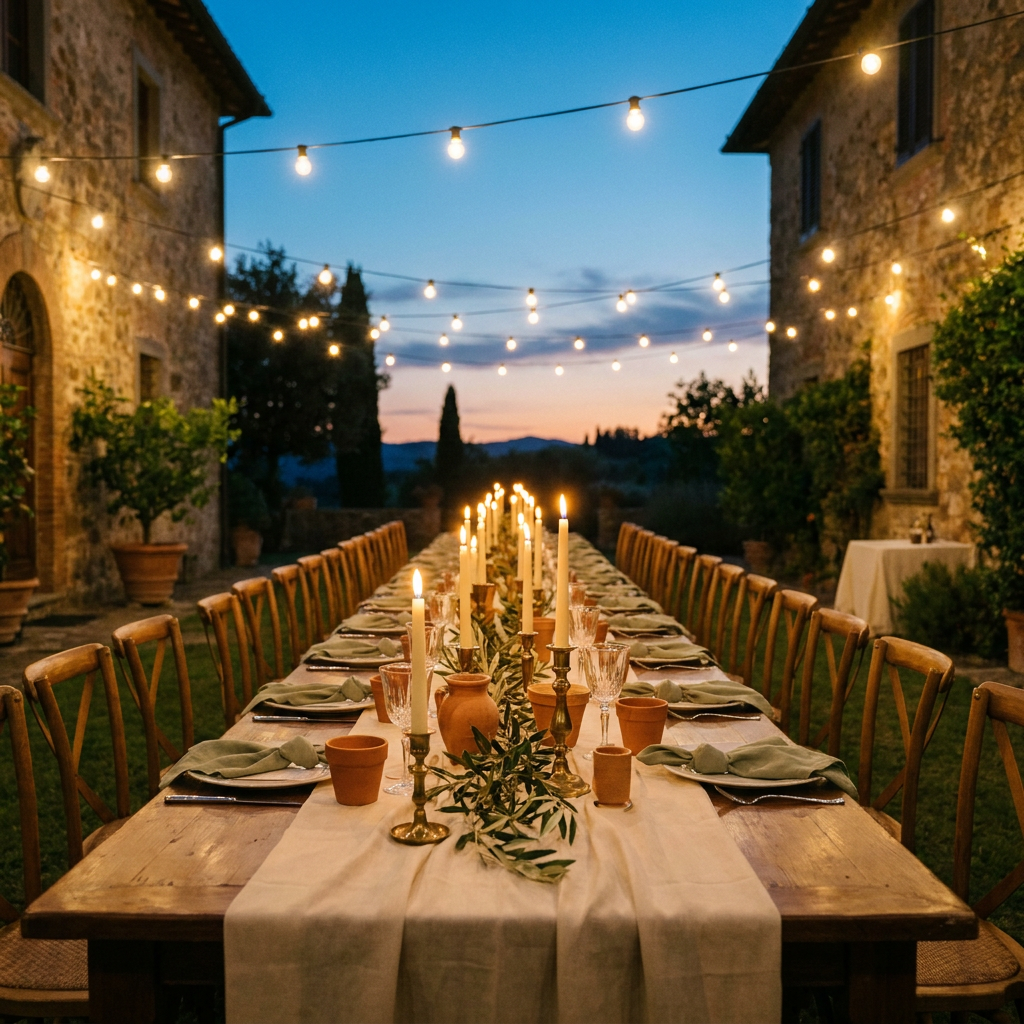
Most couples getting married in Italy from abroad choose a symbolic ceremony and handle the legal paperwork at home.
This is not a compromise. It is a superpower.
A symbolic ceremony has no script imposed on it. No required officiant, no mandated structure, no rules about language, readings, or rituals.
Your ceremony can open with Sanskrit blessings and close with an Italian brindisi. It can be led by two officiants, or by your best friend. Nobody will hand you a template.
Add to that the way Italian venues work. You are rarely renting a ballroom for five hours. You are often taking over a villa, a borgo, or an estate for two or three days, with your guests staying on site or nearby. That changes what a wedding can be. Which brings us to the most important point in this article.
The case for a multi-day celebration
When couples ask me "one ceremony or two," my honest answer is usually: neither. Think in days, not ceremonies.
Here is why. When you compress two cultures into a single afternoon, something always gets squeezed. The tea ceremony becomes a ten-minute insert. The pheras get shortened because dinner is waiting. One family feels featured and the other feels like a guest appearance.
Spread the celebration over two or three days and the pressure disappears:
Each tradition gets full expression. A morning tea ceremony is not competing with the vows happening at sunset. A Friday sangeet does not eat into Saturday's timeline.
Guests actually understand what they are seeing. With room to breathe, you can explain rituals, teach a dance, let two families genuinely meet instead of just sitting near each other.
Nobody changes outfits in a panic. Multiple attire is one of the most loved parts of a fusion wedding. A multi-day format makes it natural instead of rushed.
Italy is built for it. Welcome dinners, long lunches, a farewell brunch under the pergola. The Italian rhythm of celebration already assumes that a wedding is more than one event.
Now let me show you what this looks like in practice, with three very different couples.
Couple 1: An Indian-Italian wedding in Tuscany
This is the pairing where a multi-day format is almost non-negotiable. Indian weddings are already multi-event celebrations, so trying to fit one inside a single Italian afternoon does neither culture justice.
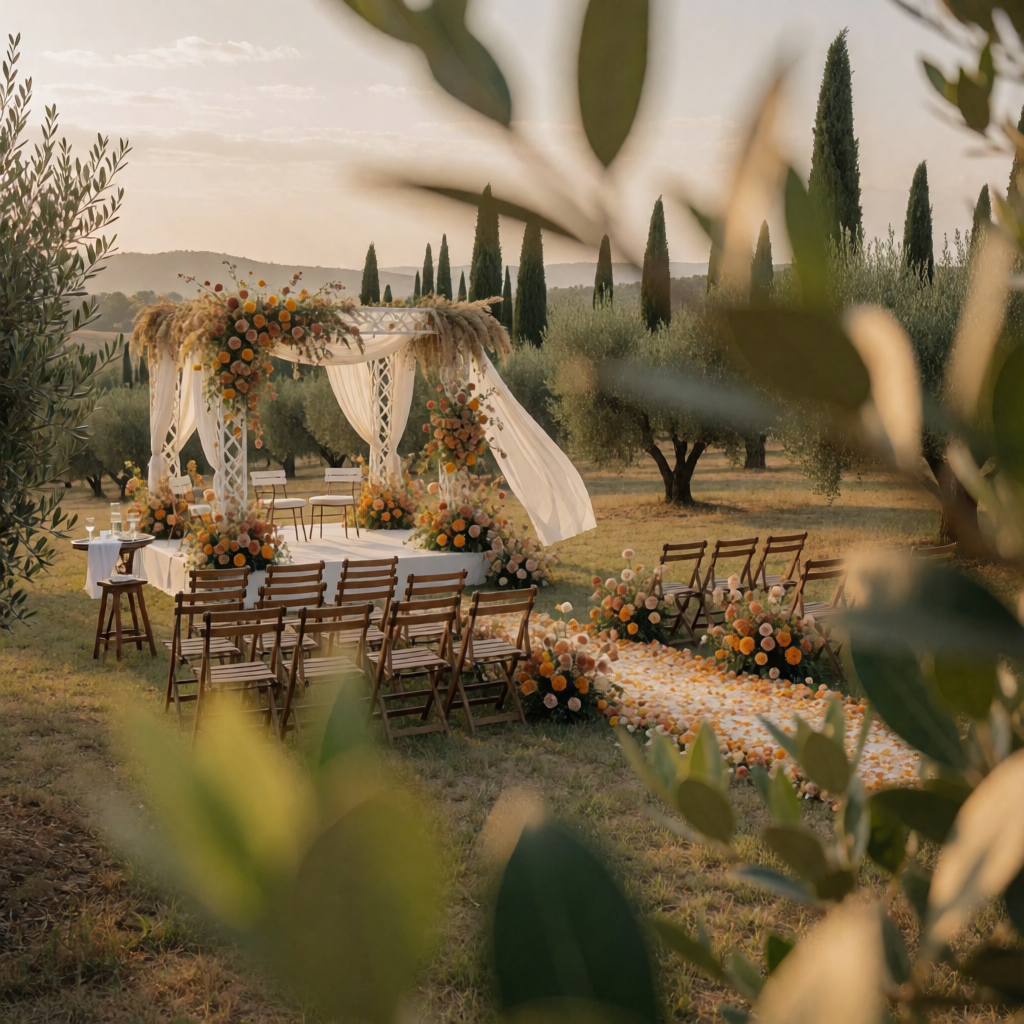
A structure that works beautifully:
Day one, evening. Mehndi and welcome dinner at the villa. Henna artists work through the evening while guests arrive from their flights. Tuscan wine, Indian snacks, low pressure. This is where the two families actually meet.
Day two, morning to afternoon. The Hindu ceremony. Baraat through the olive grove (yes, this works, and yes, your Italian neighbors will love it), then pheras under a mandap built against a backdrop of cypress trees. Lunch follows, because in both cultures a ceremony without a proper meal afterwards is unthinkable. This is one of the places Indian and Italian traditions agree completely.
Day two, evening. Sangeet energy meets Italian festa. Choreographed family dances, then a DJ who can move between Bollywood and Italian classics.
Day three. The symbolic Western-style ceremony at golden hour. White dress if you want it, vows in two languages, followed by a long Italian dinner and dancing. A farewell brunch the next morning closes the weekend.
Notice what happened there: nobody had to choose. Both ceremonies exist in full, and the villa setting holds them together visually so the weekend feels like one story, not two weddings stapled together.
Couple 2: A Dutch-French wedding on Lake Como
Here is a pairing people underestimate. "We are both European, how different can it be?" Quite different, actually, and the differences are subtle, which makes them easier to get wrong.
Dutch weddings tend toward informality, directness, and involving everyone. French weddings are built around structure: the vin d'honneur, the long seated dinner, speeches at precise moments, the soirée that goes until sunrise. A Dutch guest expects to be part of things early. A French guest expects an elegant build-up.
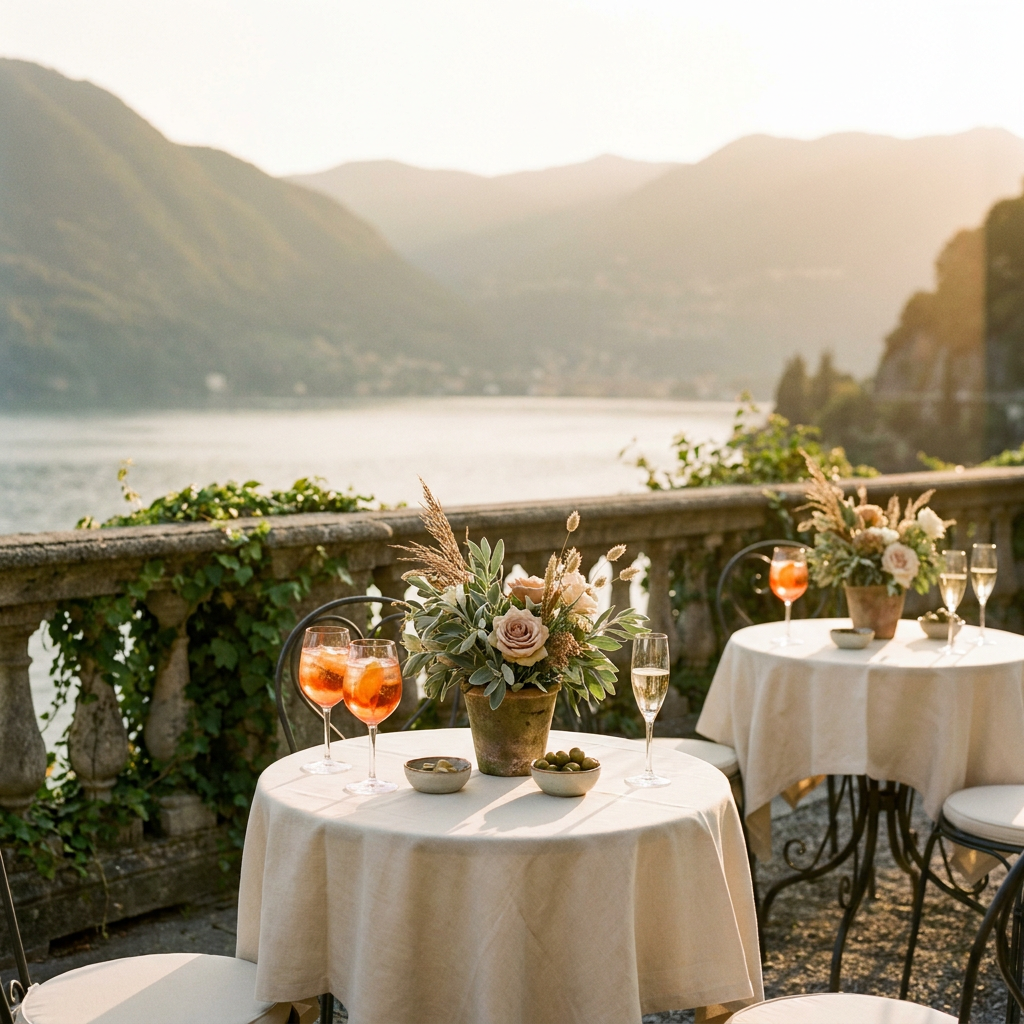
For this couple, one blended ceremony works well, but the multi-day format still earns its place:
Day one. A relaxed Dutch-style welcome evening. Informal, borrels-and-bites energy, everyone mixing regardless of which side they belong to. This front-loads the Dutch expectation of togetherness.
Day two. One symbolic ceremony overlooking the lake, in French, Dutch, and English where needed. Then the day follows a French arc: vin d'honneur on the terrace with Italian spritz standing in beautifully, a long seated dinner with speeches woven between courses, and a party that respects the French belief that a wedding ends when the sun comes up.
The lesson from this pairing: fusion is not only about visible rituals. Sometimes it is about pacing, formality, and what each family considers "a proper wedding." A good structure honors both without anyone noticing the diplomacy behind it.
Couple 3: A Chinese-Spanish wedding in Puglia
This couple faces a different challenge: two cultures with strong, specific traditions and very different visual languages. Red and gold on one side, and on the other a Spanish celebration culture where the party itself is the tradition.
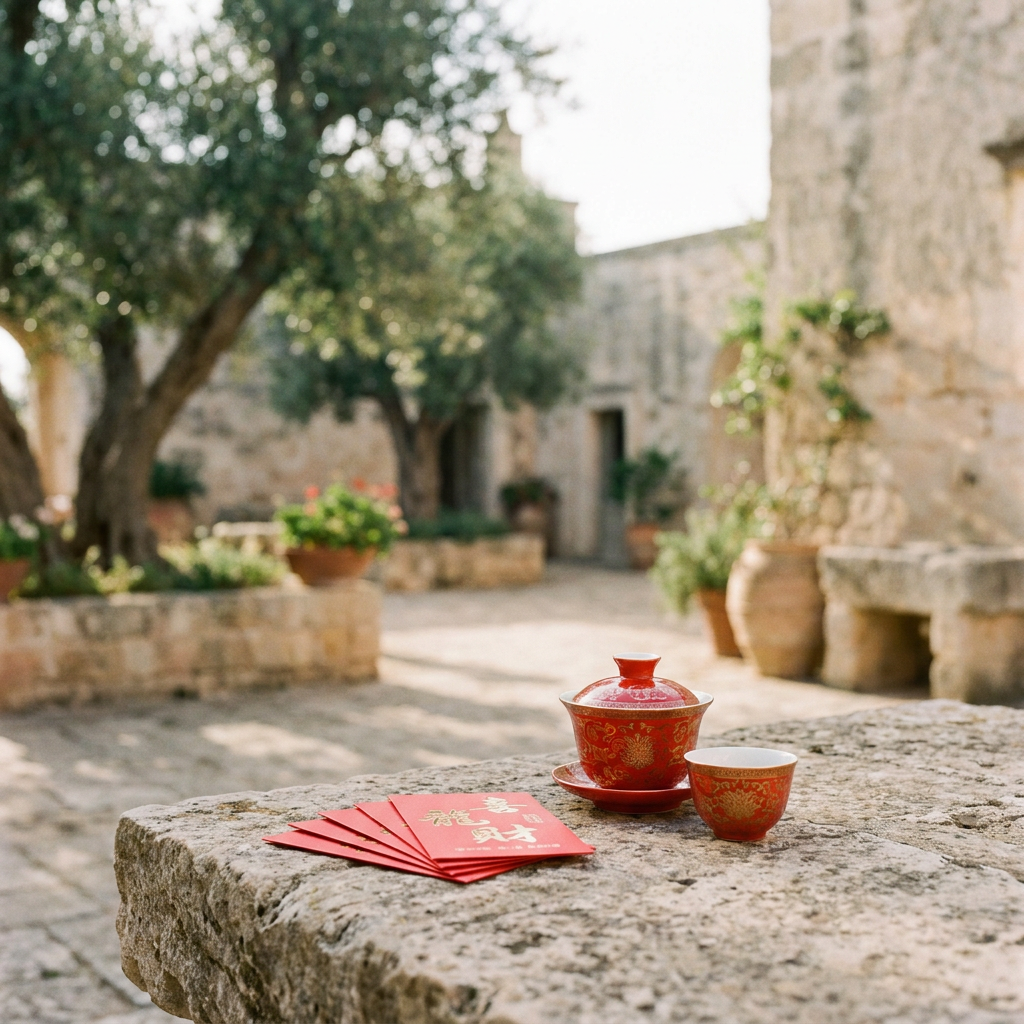
A two-ceremony structure across two days suits them well:
Day one, late afternoon. The Chinese tea ceremony, intimate, with immediate family. The couple serves tea to parents and grandparents in order of seniority, receiving red envelopes and blessings. Held in a masseria courtyard, it becomes something guests will talk about for years. The bride wears a qipao; the setting does not dilute the ritual, it frames it.
Day one, evening. A welcome banquet that leans Chinese in structure. Shared dishes, lazy Susans if the venue can source them (a good planner can), toasts moving table to table. Chinese banquet culture and the Puglian long-table feast understand each other instinctively.
Day two. The main symbolic ceremony with Spanish elements: las arras, the thirteen coins exchanged between the couple, and readings in Spanish and Mandarin. Then Spain takes over the night. Live music, dancing that does not stop, and if the families are game, a moment where the Chinese wedding games meet Spanish wedding chaos on the dance floor.
So how do you decide? Three questions
Strip everything back and the decision comes down to this:
1. Does either culture have a ceremony that needs its own space? Hindu, Chinese, Jewish, and many other traditions have rituals with their own duration, sequence, and gravity. If yes, give it a dedicated moment. Compressing it into a slot inside another ceremony rarely honors it.
2. What are the non-negotiables for you, and for each family? Ask both sets of parents one question: which one or two rituals matter most to you? Design around those pillars first. Everything else is flexible.
3. How much time can your guests give you? If most guests are flying internationally, they are already committing to several days. Use them. A destination wedding where guests travel twelve hours for a five-hour event is a missed opportunity in any culture.
A final word
“The most authentic fusion weddings in Italy are not the ones that blended the most, but the ones that chose deliberately. What gets its own moment, what gets woven together, and what the couple lovingly lets go.”
That is the real work of structuring a multicultural wedding. Not fitting two cultures into one day, but building a celebration where both families look around and think: this feels like us.
If you are working through this decision for your own wedding in Italy, get in touch!
Frequently Asked Questions
-
Yes, and it is more common than you might think. Since most international couples hold a symbolic ceremony in Italy and complete the legal paperwork at home, there are no restrictions on how many ceremonies you hold or how you structure them. Two ceremonies on one day, one per day, or a blended single ceremony are all possible at most villas and estates.
-
For most multicultural couples, two to three days is the sweet spot. It gives each tradition a dedicated moment, lets guests from different countries actually get to know each other, and matches how Italian venues are designed to be used. If one of your cultures has a multi-event tradition, such as an Indian wedding, plan for three days minimum.
-
Not automatically. A multi-day celebration adds events, but many costs are shared: the venue is often rented for the full weekend anyway, and vendors like photographers and caterers offer multi-day rates. The bigger cost driver is guest count, not the number of ceremonies. A focused two-day fusion wedding for 60 guests often costs less than a single lavish day for 120.
-
Only if you want them. Some couples invite an officiant or elder from each tradition to lead their part of the ceremony, which can be very moving. Others choose one celebrant experienced in multicultural ceremonies who weaves both traditions together. For symbolic ceremonies in Italy, either option is fully open to you.
-
Yes. Symbolic ceremonies have no restrictions on religious or cultural content, so a mandap in the garden, a tea ceremony in the courtyard, or a Jewish chuppah on the terrace are all possible. The key is choosing a venue with the right spaces and a planner who knows how to source culturally specific elements in Italy.